



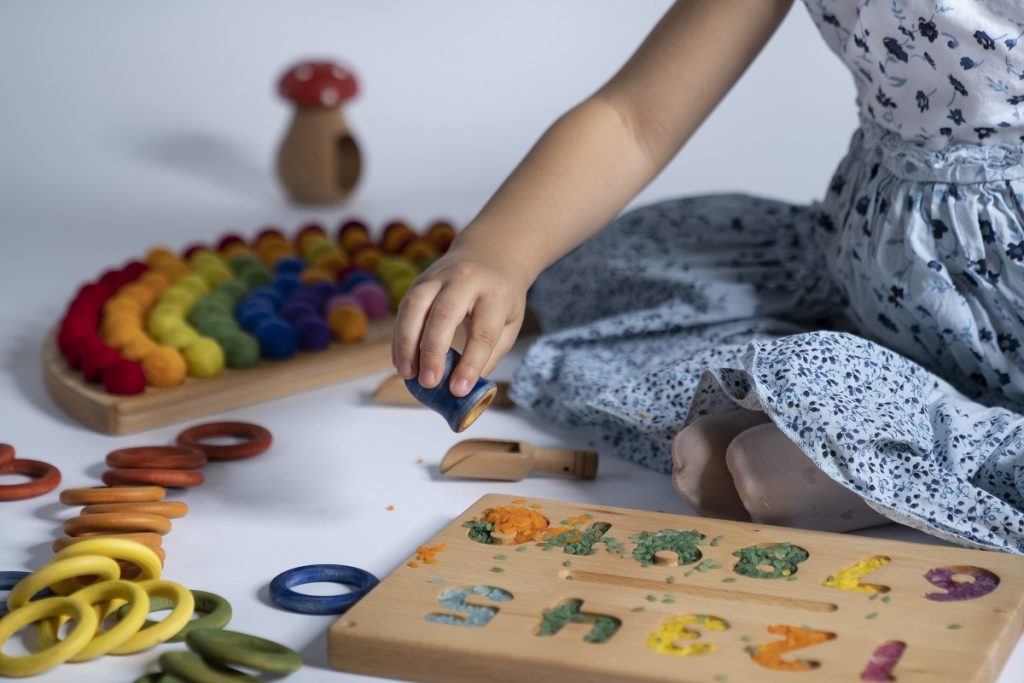
Maria Montessori was an Italian physician and pedagogue. She thought that there is already an enormous energy and urge for action in the child during the first years. The child is motivated by himself to develop and to learn. You may know her name from the Montessori schools in primary education. The purpose of Montessori education is summed up in her statement: “Help me do it myself“. Of course, you can also respond to this as a parent by offering the right toys.
Montessori accompanied young children from different social backgrounds, with and without intellectual disabilities. She noticed in all children a drive to learn that they naturally had. In every age phase, Montessori saw certain developmental themes come back: the sensitive period. The more children can be absorbed in the themes that appeal to them at that moment, the deeper their learning experience will be.
In order to guide children in freedom to grow in their development, they need a carefully prepared environment with play materials that meet their research interest at that time. “Freedom in bondage,” Montessori said. A structure is needed, for example by presenting the materials and / or products that are clear and inviting in a fixed place. This can be done by using sorting bins. There are agreements; the children learn more and more to take each other and their environment into account, so that everyone can play concentrated and enjoyable.
In offering toys, you as a parent or as a teacher can take care to see the needs of a child and respond to them by offering the right materials. In the toddler and preschool years, sorting, comparing and researching various materials is often in the foreground. In particular, learning by using all the senses is a wonderful way for young children to discover the world. In our webshop you will find many materials that fit this.
This wooden rainbow is a playful challenge for the fine motor skills of the hands! Shape and color recognition is trained with fun playing with these colorful bows. But you also challenge children to make their own constructions.

The wooden tracing board with the letters of the alphabet helps your child to practice handwriting skills. Trace your finger or the wooden stick over the engraved wood, perfect for 2-4 little ones to learn to write. Perfect educational toy to refine fine motor skills. Of course, children can follow the letters with their fingers or the stick. Another suggestion is to fill the letters with natural materials, such as corn, split peas, seeds. One side of the board is provided with the capital letters and the other side contains the writing letters of the alphabet.

Re-wood’s figures are cut down the middle. This makes it possible to fill in the numbers and learn in which direction the numbers are written. A nice preparation for school learning in group 3. But not only can you trace the numbers with this set, you can also have children place the correct number of balls on the corresponding number. A handy way to teach children about number sense and quantities. In short, wonderful development material for preschoolers for home, childcare and school!

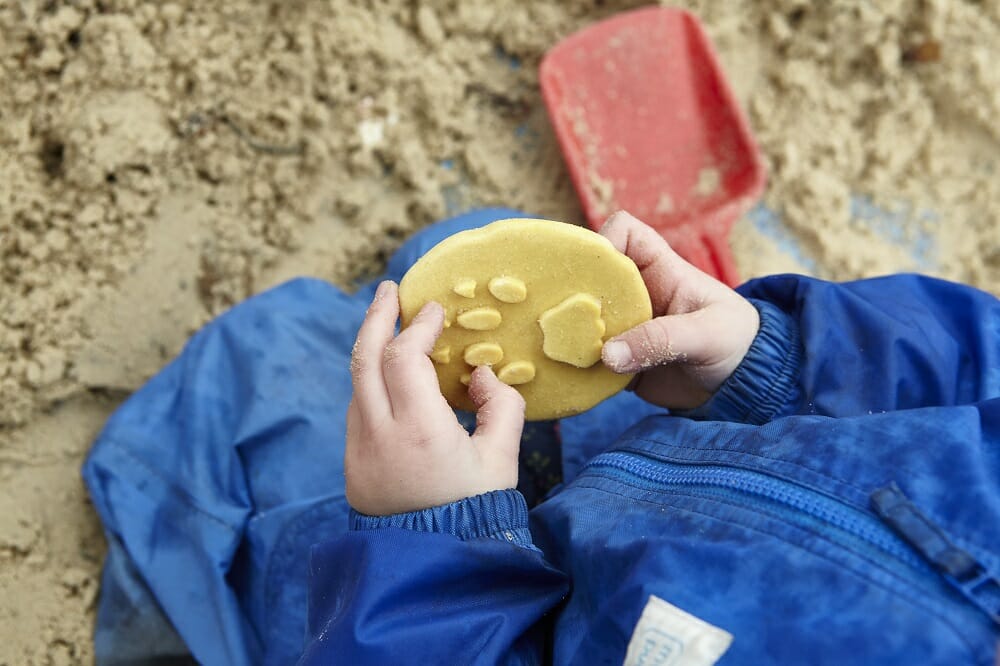
Take a walk through Africa with our footprint bricks. Discover the type of animals you can find on the African savannah as you follow their tracks. Each stone has a raised texture of a footprint on one side, and the related animal is engraved on the other. Look out for the following animals: lion, elephant, rhinoceros, giraffe, hippopotamus, ostrich, cheetah, and zebra. This set of wild animals will spark a lot of debate about the food they might eat and whether they are in danger. Ideal for talking about conservation and how children relate to the natural world. The safari footprints are also ideal to use for messy play and convenient to clean.
Made from sustainably sourced and FSC-approved beech wood, this wooden sorting tray is designed to encourage counting, sorting, and presenting materials! The nine boxes are arranged in a matrix of 3 x 3. D wooden sorting bin is perfect for helping children sort by certain criteria, such as size, shape, number, color or pattern. Likewise, it offers plenty of opportunity for exploration. The size of the sorting scale makes it practical and portable for children to collect objects from outside

Find out who is hiding deep in the forest! These stamp rollers will increase understanding of our natural world and inspire children to ask questions and tell stories. Simply press and roll in dough or clay and stomp with the stamps to create beautiful forest scenes. Count the rabbits in the burrow, hide the squirrel in the tree trunk and help the spider weave its web, while developing fine motor skills. Kids can experiment by using different amounts of pressure and rolling in different ways – away, towards and over their body in the middle.

You may also like
Do you find this article interesting? Share it via social media