


I remember well how as a little girl I built entire universes in my bedroom. My stuffed animals were the main characters, the adventures were endless, and the world I made in my head was as real as the world outside my window. No one else saw those universes, but to me they were everything.
What I didn’t know at the time is that I was working on something that child psychologists and pedagogues have been researching for decades: narrative play. And the conclusion is always the same. Imagination in children is not just a fun pastime. It is one of the most powerful engines behind a child’s development. From that conviction, Vos Wil Vliegen was conceived: a card set with which toddlers, preschoolers and older children come up with endless new stories together with a parent or supervisor.
Imagination play is the way young children understand the world. In a story, they can try out situations that they cannot or do not want to deal with in real life. They explore what it means to be afraid, to dare to do something, to help someone… safely, at their own pace, in their own words.
That makes fantasy play so much more than entertainment. It is the place where language development, emotion regulation and social skills come together. A child who tells stories practices without noticing it with word choice, sentence structure and the articulation of feelings. A child who lets a character struggle with a challenge also learns how to deal with difficult emotions. And a child who builds an adventure together with a parent or caregiver experiences real connection, without right or wrong answers.
This applies to all children. A highly sensitive child, or a child with a different neurodivergence, also benefits enormously from the safe space that a story offers. A character’s distance makes it easier to explore big and unfamiliar feelings.
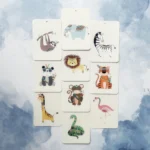
Vos Wil Vliegen makes narrative play concrete and accessible. The set consists of 20 animal cards, 20 location cards and 20 story starters. For example, a child picks up a red panda, a swamp, and a card with the command to open a secret door through a special song. This gives it a main character, a world and a challenge in one movement and the adventure can begin.
What happens next is entirely up to the child. The red panda may have glasses, be shy, or have characteristics of ADHD. The swamp can be dark and exciting, or light and colorful. Halfway through, a camel may come to the rescue. Everything is allowed, nothing is mandatory. That is exactly the power of open-ended toys: they adapt to the child, not the other way around.

The benefits of regular narrative play are piling up.
The card set from Vos Wil Vliegen works as a toddler toy and for preschoolers, and can be used both at home and in a professional setting. Take one card or three or six! The child decides. The magic isn’t in the rules, but in what happens once the cards land in curious hands.
More information and ordering via www.voswilvliegen.nl.
Watch the video about this beautiful product below