




You may recognize them, that student in your class who chews on the top of his pencil, puts his fingers in his mouth or sucks on the t-shirt or makes excessive noises? You may have already addressed the student about his behavior, but there is no change. And you wonder how to deal with this chewing need.
Your student’s chewing behavior has a function. It can help your student to regulate tension, but it can also help your student to increase his alertness. Biting on a pencil or chewing chain then helps the student to be more concentrated and to work better. Unlearning chewing and sucking on clothes or pencils is then a missed opportunity.
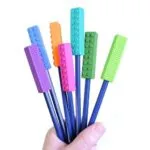
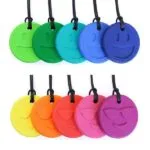
And you may also notice that chewing increases in some students during stressful times in the classroom. Especially in that student (with autism) who has difficulty with changes, chewing will increase. Chewing offers that student peace.
But how can you, as a teacher, provide your student with the right sensory stimuli to calm or activate the body? In this article, we’ve listed 7 chewing need ideas to support your student in the classroom.

When you, as a teacher, start offering sensory stimuli to the student. Then try only one tool at a time for a number of days.
A chewing piece of jewelry is an easy-to-use tool in the classroom. See if the oral input of a chewing chain helps the student. If no difference is seen after a few days, try offering another sensory stimulus.
If possible, collect data throughout the day to see if there is any change in your student’s self-regulation, attention, behavior, or emotional state (after administering the sensory stimulus). To do this, make a list of fixed measurement moments (when working independently, at instruction moment and at group work and this at an average of 3 moments per day).
You may also like these articles
You can come to us for chew jewelry and more sensory aids -> Read more about aids
If you find this interesting, share it via social media
