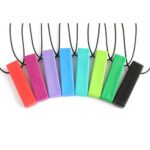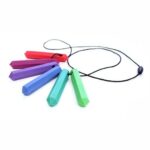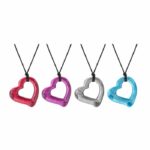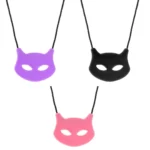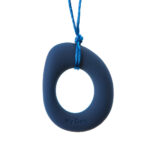




Which bite chains are the most recommended by parents? That is exactly the question that parents of stimulus-sensitive children ask time and time again, and rightly so. The range is overwhelming: one webshop swears by silicone, the other by wood. And then there are those dozens of shapes, drops, pens, pearls, butterflies. In this article you can read which bite chains parents recommend most often, what determines the choice of material, how firmness levels work, which quality marks really say something and how to keep a bite chain safe to use.
At Educadora, chew jewelry is carefully selected based on clinical knowledge and practical experience of remedial educationalists and parents together. The range does not consist of random products, but of models that have been endured in daily practice, figuratively and literally.
If you read through parent forums and compare reviews of specialized webshops, you will regularly see the same names pop up, such as the Chewigem Eternity. These are often discussed positively, and several models from the Educadora range are also regularly recommended. This is no coincidence. The most recommended bite chains by parents score well on the criteria that parents give the most weight: sturdiness and safety.
A mother of an eight-year-old with ADHD describes it this way: her son had worn out three cheap bite chains in two months, until she switched to a sturdier silicone model. Since then, one has been going to school every day. You can recognize that pattern in many reviews: the difference is not in the price or in the strongest bite chain, but in how well the product matches the chewing intensity of the child.
When parents explain why a bite chain is good, the same characteristics keep coming back. Firmness that doesn’t collapse too quickly is at the top: a bite chain that tears after two weeks is not only a waste of money but also a safety risk. In addition, the mouthfeel plays a major role. Some children accept a bite chain only after trying it a few times, and a pleasant texture shortens that acceptance process and sometimes also the flexibility of bending the bite chain. Appearance also counts: a chewing piece of jewelry that looks like a regular necklace does not attract attention at school or in the supermarket, which is important for many children.
Remedial educationalists who work with chewing jewelry regularly point to a connection that often surprises parents: the more attractive the design of a chewing jewelry is to the child, the more consistently a child wears it. Parents confirm this in reviews, a tool that a child proudly hangs around the neck is used. One that hides it in his bag, not. But the reaction of the environment is also important, who do not disapprove of the use of the bite chain but understand it. At Educadora, this insight is leading in the product selection, which also looks at more discreet ones for teenagers and adults.
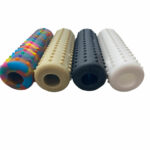
Bite chains are used in very different situations, and a different type fits for each scenario. Children have a personal preference ranging from soft silicone variants to somewhat harder bite chains with a smooth or slightly ribbed structure. They are all appropriate to support children in their oral stimulus needs.
At school, P-shapes and X-shapes are a popular option for children who chew hard and need more reach towards the molars. A bite chain in the form of a drop is compact, discreet and easy to hold in the mouth while listening, practical as an aid to concentration for lighter chewers. At home, as a resting moment anchor, parents more often choose a piece of chewing jewelry with a different texture than the school model, so that the child also experiences the change of context sensorially.
Material is the first decision you make when choosing a bite chain. Fortunately, that decision is less complicated than manufacturers sometimes make it out to be. The materials that are seriously worth considering are food-grade silicone, wood and natural rubber. Silicone is by far the most popular, and for a clear reason.
Food-grade silicone and medical silicone are both free of BPA, phthalates, PVC, latex, and plasticizers. In practice, this means: safe for intensive oral contact, easy to clean and resistant to saliva and moisture. The fact that silicone is so dominant in parent recommendations also has to do with sustainability. For light chewers, a good silicone model can easily last four months or more; For intensive chewers, the lifespan is usually between two and three months, depending on use and strength class. For the best estimate, always follow the manufacturer’s guidelines.
Silicone bite chains are also soft enough for young teeth but sturdy enough for intensive chewers, making them suitable for a wide age range. The chew jewellery range at Educadora consists of silicone models that have been selected for ease of use and have the required safety certification.
Wood has its own warm appearance and attracts parents who consciously choose a more natural product. If you choose wooden teething toys, make sure that the wood is untreated or finished with a baby-safe coating. Maple and beech wood are most often used in teething toys, because they are hard enough for light chewing and do not splinter when processed correctly.
The downside of wood is fair: it is less suitable for intensive chewers, because the structure can be damaged in the long run. In addition, wood is more difficult to disinfect thoroughly than silicone. Natural rubber is a third option, biodegradable and pleasant in texture, but always check that it is latex-free for children with latex sensitivity. For daily use at school or as a structural aid in stimulus processing, silicone remains the most practical choice.
The sturdiness of a bite chain is perhaps the most underestimated factor when purchasing. Too soft for an intensive chewer means: broken within a week and possibly small pieces of silicone in the mouth. Too hard for a light chewer means: a bite chain that is never used. So the choice starts with an honest assessment of how your child chews. And sometimes it requires the purchase of several necklaces to determine what works for your child.
Most manufacturers work with firmness classes, indicated by terms such as soft, medium, firm and intensive (manufacturers sometimes use their own designations Soft, Standard, XT or XXT for this). Soft is intended for babies and toddlers who suck more than chew. Medium is suitable for primary school children with a regular chewing need. Firm and intensive are available for children and teenagers who chew really hard, often children who damage clothing, pens or other objects without a bite chain.
For children aged four to eight with a moderate to intensive chewing requirement, the rule of thumb is: start with the solid class and switch to intensive if it wears out quickly. The reasoning from orthopedagogical practice: a bite chain must resist (be somewhat flexible), otherwise chewing has no regulating effect. Therapists who work with chewing jewelry confirm that a child without that resistance is looking for another outlet, often a less desirable one. If in doubt, consult a remedial educationalist or occupational therapist for personal advice.
The P-shape and X-shape are best suited for children who like to chew in the back of the mouth, towards the molars. Those longer arms give more reach and are also easier to hold for small hands. The teardrop shape is more compact and works well as a discreet tool in the classroom, especially for children who chew or suck in the front of the mouth.
Compact, round shapes are the most accessible to young children: less likely to be put too far in the mouth and easier to handle without adult help. At Educadora you can filter targeted chewing intensity, which greatly simplifies the selection process for parents who buy a chewing piece of jewelry for the first time.
Many product pages say “safe” or “BPA-free” in large letters, but those terms alone don’t mean much without the test results behind them. Fortunately, there are concrete standards that a good bite chain must meet, and those standards are verifiable.
Bite chains sold as toys or children’s aids in the EU are subject to a number of standards. EN 71-1 tests mechanical safety: tensile strength, small parts, sharp edges. EN 71-3 tests the migration of chemical elements from the material, i.e. whether substances are released on contact with saliva. REACH is the European chemical regulation that restricts or prohibits hazardous substances in products.
CE marking indicates that a product complies with the applicable EU regulations. It is a conformity indication, not a separate quality mark. Some providers also have SGS tests carried out: an independent laboratory test that provides extra certainty about material composition and chemical safety. At Educadora, only products that have the required EU certification and where safety documentation is available are offered. When in doubt, always ask for the test report, reliable providers provide it without difficulty.
A few signs quickly tell you that you better look further. No mention of material specifications, no test report available on request and a price that is suspiciously low for a product presented as food-grade silicone: these are all reasons for caution. Bona fide providers are always transparent about material and test results.
Also check the bite chain itself regularly. When you see cracks, flaking, nicks, or a changed texture, it’s time for a replacement, not in a month, but immediately. A damaged bite chain can loosen pieces that a child swallows, and that risk never outweighs the cost of a new one. Manufacturers of certified chew jewelry use this replacement rule as standard in their instructions for use.
A quality bite chain requires little maintenance, but what you do, you have to do well. Improper cleaning affects the material structure and shortens its service life. The rules are easy and quick to learn.
For daily use, warm water with a mild soap is sufficient. Rinse well to remove soap residue, because soap residue gives a bad taste that makes many children give off from using it. Then let the bite chain air dry completely, which usually takes fifteen to thirty minutes, before you give it back.
For more thorough disinfection, you can briefly sterilize silicone bite chains in boiling water or place them in the dishwasher, but always do this without the cord and check the manufacturer’s instructions beforehand, as some models have limited heat resistance. Then allow the product to cool completely before use. Do not use harsh bleach solutions or chemical cleaning agents on silicone: these affect the material structure and can leave residue that is not safe for oral contact.
There is no fixed replacement period that applies to every child, because the wear and tear depends directly on the chewing intensity. For light chewers, a good silicone model can easily last six months or more. In intensive chewers, this can be shorter, sometimes after two to three months.
The practical rule of thumb: inspect the bite chain once a week with your thumb and index finger. Do you feel indentations, do you see cracks or discoloration, or does the texture feel different than when you bought it? Then you replace it, no matter how long you’ve had it. Make this a regular part of your weekly routine, just like you check a pacifier. This keeps the tool safe and effective, and you notice in time when a new model is needed.
Which bite chains are the most recommended by parents? Again and again, they are models that have three things in common: food-safe silicone as a material, a firmness that matches the child’s actual chewing power, and a demonstrable safety mark. Cheap alternatives without a test report seem to be an advantage in the short term, but parents regularly indicate in reviews that replacement due to wear and tear or safety doubts quickly cancels out the savings.
The right choice always starts with the child itself. How old is it? How intensively does it chew? In which situations does it benefit most from a chewing piece of jewelry, at school, at home, on the road? These questions determine the level of strength, shape and design. When in doubt, a remedial educationalist or occupational therapist is the best conversation partner, because what works for an eight-year-old intensive chewer is a different choice than what works for a four-year-old with mild sensory needs.
At Educadora, chewing jewelry is central that has been selected on the basis of orthopedagogical knowledge, ease of use and safety. The range is tailored to different ages, chewing intensities and usage scenarios, and the team provides personalized advice if you can’t figure it out. Feel free to contact the Educadora team to discuss which chewing jewelry best suits your child.