



In the development of a young child, the development of gross motor skills starts at an early stage. However, fine motor skills only start to develop step by step later and extra supply and stimulation is certainly recommended.
In this blog, I will therefore discuss a number of activities and tools that can help your preschooler to develop as optimally as possible.
It is not for nothing that in kindergarten people cut, tear and sort pompom balls and beads with tweezers. The purpose of this is to train muscle strength in the hands, eye-hand coordination and of course fine motor skills. This is a good preparation for learning to write. After all, control is needed over the degree of muscle strength and the fine movements to be able to place the curls and letters on the right lines and a correct pen grip certainly requires some extra practice (often there is a fist grip up to the age of 3 years).
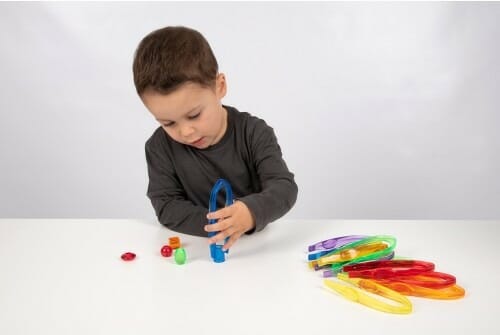
Sorting plastic figures and using large tweezers is a great activity for your child to stimulate fine motor development. Look at your child’s perception of the world and connect with it. Choose dinosaurs or family figures. If necessary, use sorting bins.
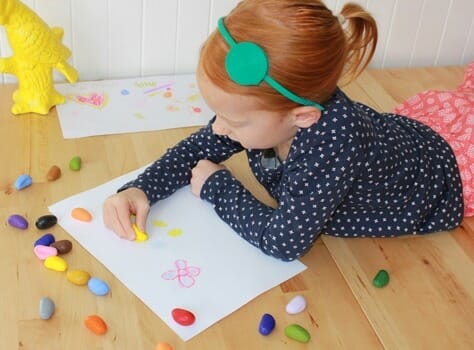
Most children find drawing and coloring a relaxing activity, great for de-stimulation, but also for practicing fine motor skills. Learning the pen grip is not easy, but with the crayon rocks children learn the correct pen grip in a natural way. The advantage of these crayons is that your child does not need a lot of muscle power and will therefore have more fun coloring.
This set consists of balls and tubes. With the included assignment cards, your child learns to make figures. The skeletal geo starter set not only appeals to the fine motor skills but also to the spatial-visual skills of your child.
Another fun activity is stringing. Have your child string macaroni pipes on a cord, or string beads. Manoeuvring the cord through the small openings requires good fine motor skills and eye-hand coordination. Instead of beads, you can also string with pompoms .
The water is always well suited for a play activity. Most children enjoy sensory play with sand and water. Let your child scoop figures out of the water. Fill a bowl with water and use the Handy Scoopers to scoop your child out of the water. This is used to practice the handling of scissors. Or fill a container with playfoam pluffle and fruit figures.

I still remember it from the past, the lancing device and the lancing pads. My children also found this a fun activity. And is definitely recommended to work on fine motor skills in a playful way.
To prepare your child for learning to write, there are plenty of examples of zigzag lines on the internet, wavy lines to have your child draw to learn to dose the hand movements. Of course, it is also a way to follow your child’s lines with their fingers and thus literally feel them. Use our feelers for this preparatory writing. Another very nice tool are the tracing boards that help your child to make the same movements with both hands at the same time (this set is certainly also suitable for older children, it seems easy, but it is not!).

The tracing boards with letters of the alphabet or with numbers are also useful materials for practicing preparatory writing. And also fun in combination with being sensory.
The iron-on beads remain popular, for young children there are even larger iron-on bead sets. Then you can switch to the regular iron-on beads and with the available examples, frames and booklets, there is something fun for every child that they will enthusiastically work with. Just think of princesses, cars, animals… Also check out our peg board as fun fine motor play material.
A game that is always a success, Jenga! It is an art that your child and you take turns sliding the blocks out of the tower as carefully as possible. This requires concentration, a good balance in muscle strength and fine motor skills.

What?! Indeed, shaving cream is a very successful way to stimulate fine motor development. Spray a large dollop of shaving cream on the table (put an oilcloth underneath) and let your child draw figures, write letters, draw numbers. A very handy and fun way to learn while moving. And for another fun sensory effect, you can consider the happy senso .
-> Read our tips to stimulate gross motor skills here
Do you have a nice tip?
Do you like this article? Share it on social media