



The beginning of a school year literally means a new start for a number of children, often a new teacher, new children or even a new school. Expectations have been cultivated again and hopefully as a parent it will be possible to set up a pleasant cooperation in the interest of your sensitive child with everyone involved with your child.
For a teacher it is also a new start, also getting used to. And the children are expected to adapt to the culture of the school and the expectations of the new teacher.
And on top of that, the children have to contend with the most sensory environment in the world! Because let’s face it, that swarming when the school bell rings and the children thunder into the school. That will also come to you! And what do you think of the mass of students who all remain at school together in the auditorium? Have you ever experienced it? So it’s not surprising that going back to school can cause stress for many children. And especially with sensitive kids!
But the start of the school year does not have to be negative. On the contrary, together with the teacher and your child, you can work to better arm your sensitive child and learn to grow. Discuss with the teacher which simple calming sensory strategies can be used. Simple interventions and tools that help your child get through the school day well.
A quiet space where your sensitive child can retreat for a while when he needs a break. A quiet space can be a corner, furnished with a beanbag and nice cushions or a tent. A quiet space is a great way to limit auditory, visual, and other input from your child so they can settle down.
In that space you can add a weighted cuddly toy which they can take on their laps. Weighting helps a child calm down. Have the teacher make agreements in advance about the use of the space with your child. A small signal or gesture is desirable so that the teacher knows that your sensitive child needs some ‘me-time’.
Offering tactile input is easy. Fill a large container (preferably a nice large transparent container that is not too deep with sensory material. Think of play sand, glibbi, water beads or dry rice (possibly colored with dye) and let children fidget in it with their hands. Add some toys, you can make a theme box and adapt it to the theme.
Applying deep pressure to the body with a weighted blanket or weighted cuddly toys also provides calming tactile input in children who are at risk of becoming overstimulated at school.
The oral system can provide rest and self-regulation for many children. Chewing on appropriate materials can provide soothing oral but also proprioceptive input. Offer children something that they have to chew on a lot, such as crackers, nuts, carrots.
But what can also work is to do a lot with the mouth area. For example, drinking a thicker liquid (yogurt) through a straw, but also blowing through a straw the other way around. Think of making a beautiful (water) paint drawing by moving the paint by blowing. Or trying to blow a soft ball over a line.
But you can also use special chewing jewelry to provide oral sensory input. We have a wide range of chew jewelry from Chewigem and Ark Therapeutic.
One of the quickest ways to help children who are overwhelmed by noise is to make the environment quiet. So, use a calm voice to get a child’s attention. In a classroom you can work with a sound meter and draw children’s attention to this.
Hearing protection is also often used for sensitive children to muffle the sound. However, if a child uses this a lot, it can become more sensitive to sound. It is important that children remain exposed to noise.
What is a good option is to use an MP3 player while working independently in the classroom. Use classical music or nature or ambient sounds on it. And the regular noises in the classroom (such as sliding chairs, falling pencils, walking children) are drowned out.
Some children are overwhelmed by visual input. The movement of children, the bright light, the many posters and diagrams on the walls in a school setting can just be too much.
There is usually enough natural light coming through the windows during the day so that the children can see. Then it is nice if the light can be dimmed a bit to reduce visual stimulation.
It’s also important to limit other visual distractions in the learning environment for children who are easily visually overstimulated. Make sure your classroom is tidy. Do not leave supplies and materials on tables unnecessarily, but have them cleaned up. Also think carefully as a teacher about what to hang or not to hang. Only the most important thing. Or choose 1 wall with a lot of hanging and make sure that the stimulus-sensitive students sit with their backs to that wall. Our concentration screens also offer a good alternative for too many visual distractions.
Calming visual activities that can be used during class are playing with sensory tubes (filled with water and glitter or with water and water beads or you name it), but also looking through a kaleidoscope or lava hourglass or fun drip track can help a sensitive child to relax.
Many children benefit from proprioceptive input in the form of heavy work. Heavy work means moving the body against heavy resistance. This provides stimulation for the muscles and joints so that the body can calm down. [read more about the proprioceptive system]
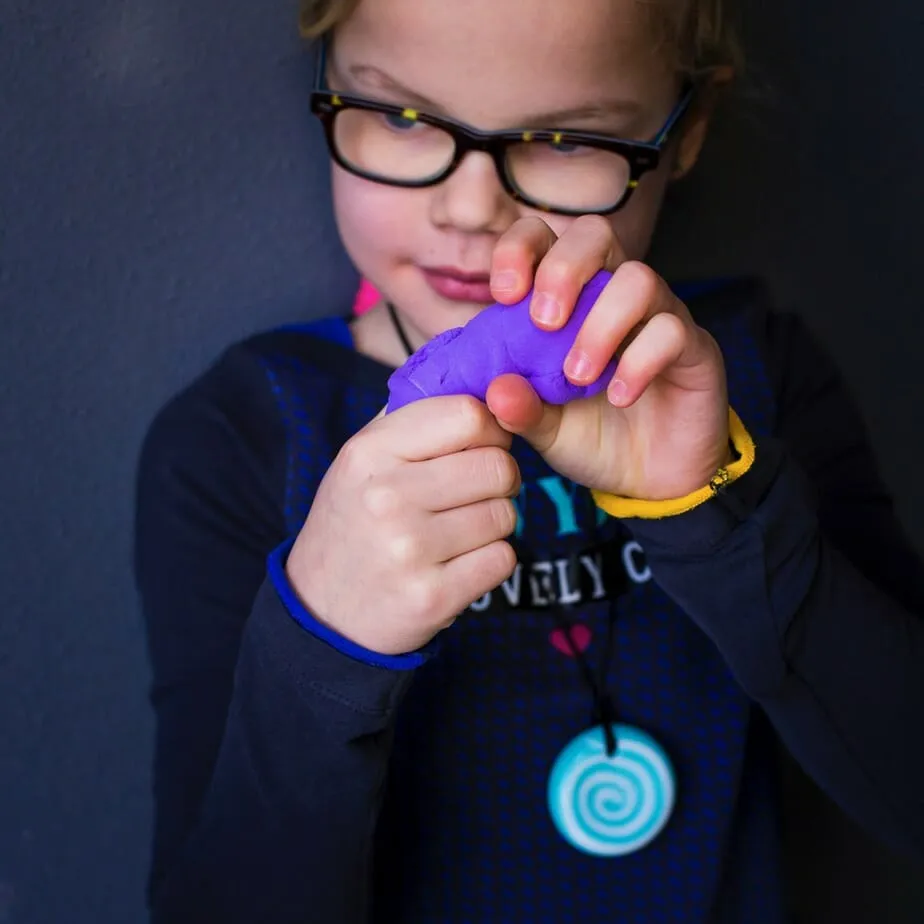
Heavy work activities are: playing with play dough pushing with the feet against elastic (which is attached to the chair legs), moving furniture, carrying books or blocks.
Chewing against resistance is another great way to provide calming input to the proprioceptive system. [Read tips for children with chewing needs here]
Many sensitive children find repetitive and rhythmic vestibular input, such as rocking, very nice to relax. This kind of sensory input can help when your child is overstimulated. So add a rocking chair in the space. But also letting it roll back and forth slowly, lying on a large gym ball can have a calming effect.
Fine motor-visual tasks that are repetitive can also have a calming effect on your sensitive child. Think of the following options: – Stringing beads – sorting tasks (with pompom balls or beads or coins, learn to count, sort by color)
Despite all the use of sensory aids and activities, is your child still overstimulated? Then read our tips here on what to do in case of overstimulation?
Which of these tips are applied to your child in the classroom? Do you have any additional tips?