



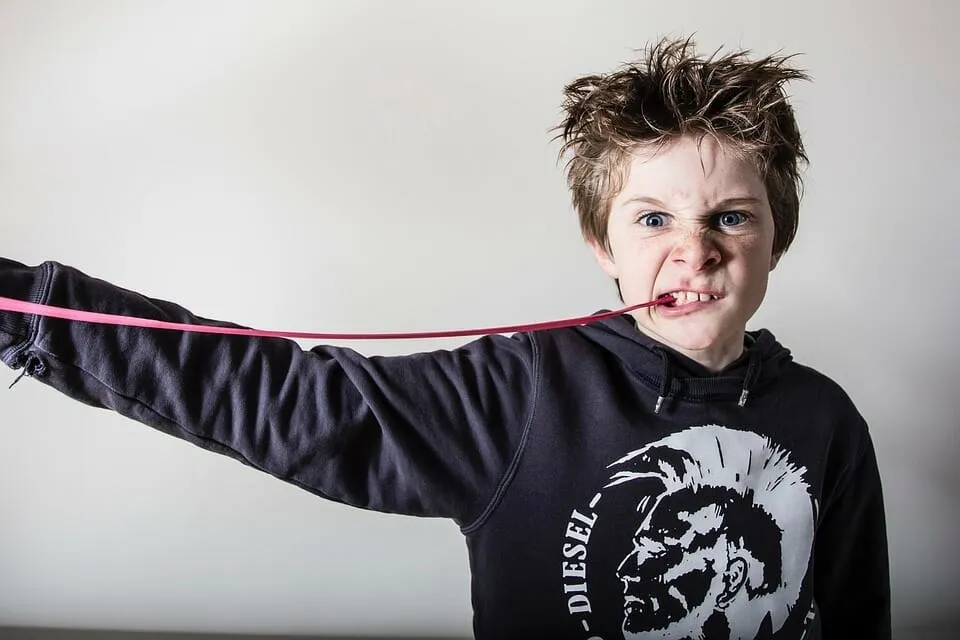
Some children chew or suck on their collar, their hair, their fingers, the end of their sleeve, or on the cords of their hooded sweater. Other children are more likely to chew or bite on products that are firmer and more resistant. Think of pencils, the edge of the bed or keys. In this article, we would like to give you valuable tips for chewing needs.
Chewing on products that are not suitable for consumption is not wrong.
Taking something in the mouth, chewing on something, is part of a child’s natural development. Children start to explore the world around them with their mouths and so children learn a lot about structures, patterns, how something feels, hard or soft, in the first 1-2 years of life.
Over time, a child no longer needs to explore the world through the mouth, then feeling by hand is enough to learn more about the properties of products. And yet after this phase you still see children who do put things in their mouths to chew.
Chewing can be helpful for older children. The “heavy” sensory input that chewing provides to the mouth and jaw (also known as proprioception) can calm the overstimulating nervous system. (This is how you recognize adults, but also children, who bite nails when they are tense). Or that baby who relaxes from sucking on a pacifier or with thumbs. He learns to relax by sucking or biting.
But did you know that chewing can also help children who do not get enough sensory stimuli, children who are understimulated , as it were, the so-called dreamy types? Chewing provides them with extra sensory input, which improves their concentration and attention.
So even for stimulus seekers or if your child has been inactive for a long time, chewing helps to ‘pep’ the brain. That’s why some people like to chew gum. Activating the brain through chewing helps children (but also adults) to focus, so that they can concentrate better. Read more tips to help your child concentrate in class here.
Although chewing can be good for a child in some cases such as the above, chewing can become a problem when the child is focused on chewing. A child is then insufficiently able to perform daily activities (such as playing, doing homework and brushing teeth).
Chewing can also become a concern if it starts with self-injury (chewing on the nails or skin until it bleeds) or when materials are chewed to pieces (such as pencils, clothing or furniture). Chewing can also be a danger to a child, they are exposed to potential suffocation or chemical hazards (such as with pieces of pencil, eraser, chewing on products with PVC, BPA, etc.).
Here are 5 tips to help children with chewing needs.
What is the cause? Do you see your child chewing more when he or she is anxious or overstimulated or bored? Is your child generally looking for heavy sensory input (proprioceptive input) in the oral area.
Chewing (and sucking) is a strategy of the body to calm down and organize. It is therefore useful to check whether there are patterns and possible causes. [Also read: Why children chew]

When children climb, play, jump on a trampoline, bounce on a skippy ball, pull a block cart, or carry a full laundry basket or garbage bag, their body is provided with heavy input for the joints and muscles. This ‘heavy lifting’ is also called proprioceptive input. This can also be integrated at school by having your child bring books to another class.
Lugging and doing ‘heavy work’ helps the brain organize. It provides the brain with soothing sensory input just as the chewing need provides it. This input is particularly important for children who have difficulty processing sensory information. Also think of doing exercises with the stretch-eze or the snuggle huggle.
So if your child is chewing because he or she is looking for proprioceptive input, there’s a good chance that the mouth isn’t the only part of the body that wants more heavy input, so offer more exercise.
These are examples of ways to increase proprioceptive input in your child’s mouth area. There will then be less need for non-food related products to chew.
Examples of crunchy foods include muesli, croutons, crunchy granola bars, carrots, celery, apples, nuts, licorice sticks. And chewing gum of course.
When drinking, think about using Camelbak’s bottles or having your child drink through thin straws (for thin liquids like water, juice, or milk), and thick straws (for thicker drinks like milkshakes, smoothies, yogurt, or even applesauce). (TIP: you can use the pencil cover as a straw)
Because we don’t want our children to eat all day, it is important to think of other ways to provide increased heavy input to a child with a chewing need. There are plenty of play options and materials to meet your child’s chewing needs.
Toys and activities that increase proprioceptive input into the mouth area through heavy work include inflating balloons, playing with bubble blowing, blowing on harmonica or whistles. Blowing games with straws are fun too. Create a pom pom maze game.
Chew jewelry can support children who need more stimuli. And, finally, a vibrating (electric) toothbrush can also be a great tool for kids who chew constantly. It allows for more intense sensory input than brushing with a regular toothbrush alone. The Z-vibe also offers a solution!
Chewing jewelry or bite chains have been specially developed to meet the chewing needs of children. They are useful as an alternative to biting your nails, chewing holes in clothing, or chewing on pencils.
Chewigemand Ark Therapeutic have been developing special chewing jewelry for children and adults with chewing needs for a number of years. The products are free of BPA, PVC, latex, lead and phthalate. The chew chains are divided into various chewing strengths and available in very beautiful colors and shapes. Every child wants to be seen with their favorite chew jewelry!
Do you find this article interesting? Share it on social media.